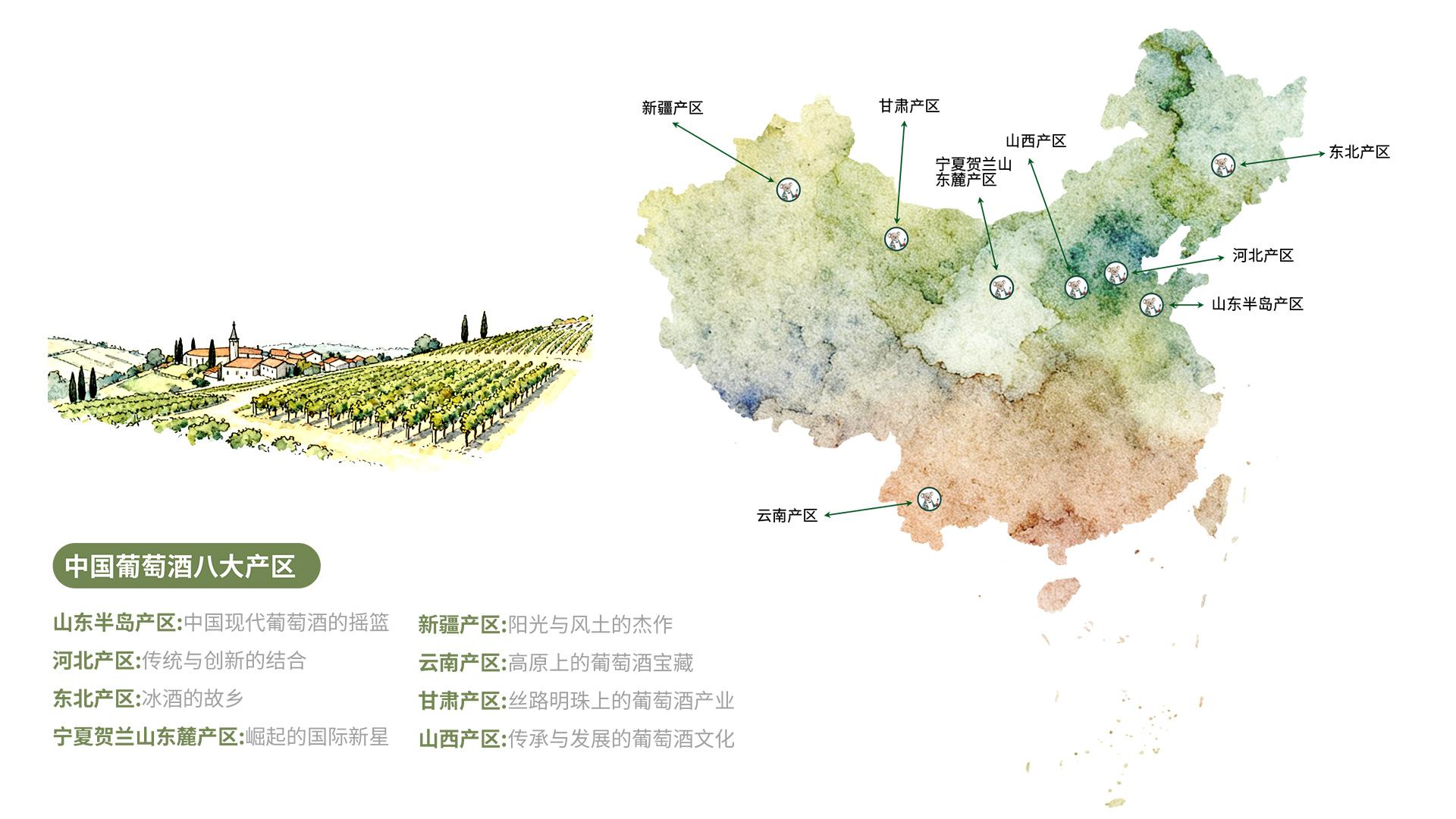




China’s wine regions stretch across a vast latitude range from 25°N to 45°N, each shaped by distinctive geography and climate to form unique winemaking identities. Here is a detailed breakdown of China’s major wine-producing areas:
1. Traditional Core Regions
-
Shandong Peninsula: The Cradle of Modern Chinese Wine
Location: Centered around Yantai, including Penglai and Qingdao.
Climate and Soil: Temperate monsoon climate, moderated by maritime influence, with mild conditions and well-draining sandy soils.
Key Varieties and Style: Cabernet Sauvignon, Cabernet Gernischt, and Chardonnay lead. Wines show rich fruit character with a fine, ocean-influenced texture. Changyu Jiebaina is a flagship brand, blending tradition with modern technique, sold both domestically and internationally.
Industry position: China’s largest wine region, accounting for 41% of national production in 2024. Yantai alone leads output, home to giants like Changyu and Great Wall.
Innovation and Globalization: The Penglai sub-region has built a “Coastal Wine” brand, exporting to over 20 countries. At the 2025 Berlin Wine Trophy, Penglai won 1 Grand Gold and 5 Gold medals. -
Hebei Region: Tradition Meets Innovation
Sub-regions: Changli, Huailai.
Climate and Soil: Temperate continental monsoon, large diurnal temperature swings, diverse soil types.
Key Varieties and Style: Changli Cabernet Sauvignon and Huailai Longyan (Dragon’s Eye) grape are iconic. Great Wall Sangan Riesling is known for its crisp fruit profile. Huailai ranks second nationally at the county level for wine production and represents 16% of the domestic market by sales volume. -
Northeast Region: The Homeland of Chinese Icewine
Location: Changbai Mountain foothills and the Northeast Plain.
Climate and Soil: Extremely cold winters (-30°C to -40°C), fertile chernozem soils suited to cold-hardy varieties.
Key Varieties and Style: Vitis amurensis (Shanputao) and Vidal dominate. The icewines are lusciously sweet with intense aromatics. Changyu Golden Icewine Valley has won multiple international awards, setting the benchmark for Chinese icewine.
2. Emerging High-Potential Regions
-
Ningxia â Eastern Helan Mountain Foothills: A Rising International Star
Climate and Soil: Temperate continental arid climate, diurnal temperature variation exceeding 15°C, mineral-rich sandy soils.
Key Varieties and Style: Cabernet Sauvignon and Marselan perform exceptionally. Wines are structured and powerful, with spice and dark fruit notes. Helan Qingxue “Jia Beilan” has won numerous international awards. In 2025, the region’s brand value reached Â¥34.019 billion, ranking fourth globally.
Industry Upgrade: Reorganized into 8 sub-regions with 5 major winery clusters. Planned 2025 output of 121,000 kiloliters, with significant export growth.
Policy Support: Designated a National Geographical Indication Protection Demonstration Zone, with land transfer prices as low as 30% of market rate, promoting wine tourism integration and smart agriculture. -
Xinjiang Region: Sunlight and Terroir in Harmony
Sub-regions: Northern Tianshan Foothills, Yanqi Basin, Ili River Valley.
Climate and Soil: Temperate continental arid climate, over 3,000 hours of sunshine annually, diurnal temperature swings exceeding 20°C, well-draining sandy soils.
Key Varieties and Style: Cabernet Sauvignon and Chardonnay dominate. Wines are fruit-forward with high alcohol. Tiansai Vineyard Chardonnay is celebrated for its citrus aromas, while Niya Five-Star Orient Cabernet Sauvignon has earned international recognition.
International Breakthrough: In 2025, Northern Tianshan Foothills producers made their first collective export to Singapore and Malaysia, securing over 30 cooperation agreements and achieving a historic export milestone. -
Yunnan Region: Highland Wine Treasure
Sub-regions: Mile, Deqin.
Climate and Soil: Mile has a subtropical monsoon climate; Deqin sits at high altitude (1,700â3,000m) with wide diurnal temperature ranges. Soils are red earth and rock.
Key Varieties and Style: Mile Rose Honey (Meigui Mi) and Deqin Cabernet Sauvignon lead. Yunnan Red wines are known for their unique regional character. Deqin’s Meili production area has 4,000 mu of organically certified vineyards, with 2025 industrial output reaching Â¥150 million and exports to over 10 countries.
Micro-terroir exploration: Deqin has designated three “star villages” (Adong, Jiangpo, Sinong) for precision viticulture, producing boutique wines that have collected over 100 international awards. -
Gansu Region: Wine on the Silk Road
Sub-regions: Hexi Corridor (Wuwei, Zhangye, Linze).
Climate and Soil: Temperate continental arid climate, irrigated by Qilian Mountain snowmelt, well-aerated sandy soils.
Key Varieties and Style: Cabernet Sauvignon and Merlot dominate, producing full-bodied wines. Linze Red Bridge Estate farms 5,000 mu of organic vineyards producing icewine and sweet wines. In 2025 the estate won international awards and expanded distribution to Shandong and eastern Chinese cities. -
Shanxi Region: Heritage and Evolution in Wine
- Location: Taiyuan Basin, Lüliang Mountains.
- Climate and Soil: Temperate continental monsoon, wide diurnal temperature variation, loess and sandy loam soils rich in minerals.
- Key Varieties and Style: Cabernet Sauvignon and Chenin Blanc lead. Grace Vineyard produces a diverse portfolio â “Grace Vineyard Reserve Cabernet Sauvignon” is noted for its spice notes and soft tannins.
3. Terroir Differentiation
- Maritime Climate: Shandong’s Penglai follows the “Three S” rule (Sun, Sand, Sea), giving wines their distinctive fresh character.
- Continental Climate: Ningxia and Xinjiang, with high sunshine hours and dramatic temperature swings, produce concentrated, full-bodied wines.
- High Altitude: Yunnan’s Deqin and Gansu’s Linze benefit from intense UV exposure and long growing seasons, yielding complex, premium wines.


Please log in to view comments